

The House of Software Value Delivery
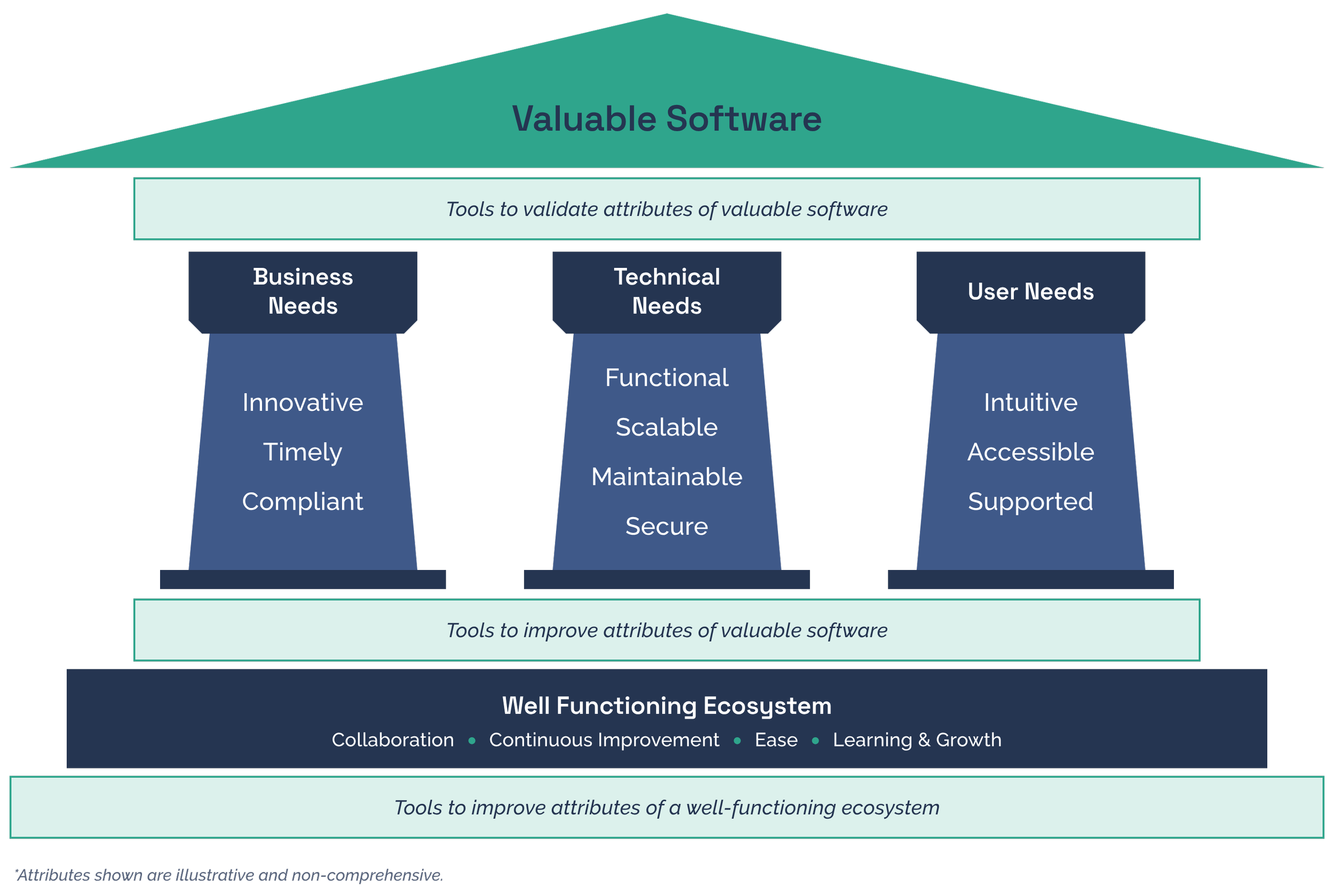
I created the House of Software Value Delivery to show R&D organizations which needs their software is meeting, which it isn't, and what to do about it.
Software is valuable when it meets needs. That sounds obvious, but most delivery frameworks skip straight to execution without asking: whose needs, and what kind?
The House of Software Value Delivery organizes those needs into three types: User, Business, and Technical. These form the three pillars of the framework. Each pillar has specific Attributes that describe what it looks like when that need is being met. For a Business pillar, that might mean Timely or Innovative. For a Technical pillar, Maintainable or Secure. For User, Intuitive or Accessible. The specific Attributes vary by organization. The framework provides the structure for identifying and naming them, not a fixed list.
The pillars rest on a foundation: the health of the delivery ecosystem itself. That ecosystem has its own Attributes, things like Collaboration and Continuous Improvement, that can be measured and improved independently of the pillars above them.
Alongside the pillars are layers of Tools. Tools at the foundation level act on the ecosystem. Tools adjacent to the pillars act on the User, Business, and Technical needs. Tools above the pillars validate whether those needs are actually being met. Attributes and Tools are fundamentally different things, and confusing them is where most process improvement efforts go wrong.
You can't turn a dial to improve Maintainability. It isn't actionable on its own. What's actionable are the Tools that influence it: your code review practices, your architectural standards, your technical debt prioritization. The same is true for every Attribute in the framework.
The failure mode I see most often: organizations measure their Tools (e.g. automated testing code coverage, ticket throughput, velocity) and treat those numbers as a proxy for the Attributes they actually care about. They optimize the measurement instead of the outcome. The House corrects that. We identify which Attributes have the most room for improvement, select Tools most likely to move them, and keep measuring the Attributes to know whether it's working.
Every engagement I do starts here, with a diagnostic against the House.
Want to learn more?
The diagnostic is also available on its own. Tell me what you're working on.