Have you heard some version of "look what I vibe-coded over the weekend"?
My first questions are always the same. Who is it for? What problem does it solve? Will anyone pay for it? Then the engineer in me asks: did anyone think about security? Scalability? Performance?
Vibe coding has a real place. It may be the best prototyping Tool we've ever had. You can put a design in front of users and find out in days whether it's Intuitive and Desirable. You can try a specific approach before committing a team to it. In House of Software Value Delivery terms, that makes it a validation Tool: it checks a design against the needs before anyone builds it for real.
The trouble starts when the prototype ships.
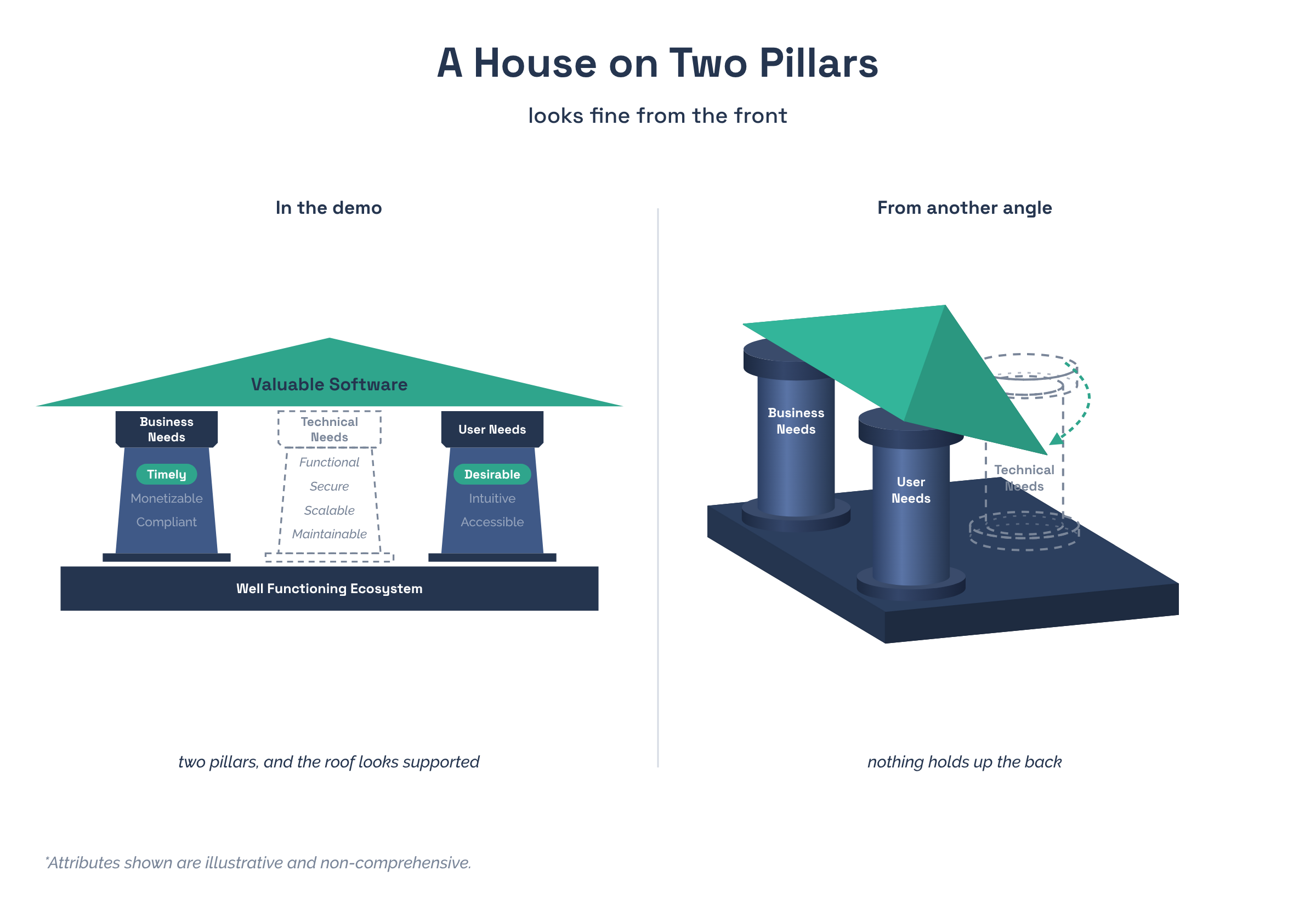
In the House, valuable software rests on three pillars of needs: Business, Technical, and User. Each is described by Attributes. Most of the vibe-coded software I've seen overrotates to two of them: Desirable, a User Need, and Timely, a Business Need. It looks great, and it got here fast. Secure, Scalable, and Maintainable on the Technical pillar never came up.
A demo shows you the House from the front. From there, two pillars look like plenty: the roof is up, and nothing seems to be missing. Walk around to the side, and you find nothing holding up the back. That's where the Technical pillar belonged. It's a classic unbalanced House, and the first real users, real data, or real attacker will tip it over. A weekend build doesn't lower the bar on any pillar. Vibe coding gets you to the demo.
Getting from the demo to software that holds up still takes the craft of software development, and much of that craft is knowing which questions to ask. I write my technical readiness checklists as questions for exactly that reason. Who should be authorized to see what portions of data? What load does this need to support? What integrations may need to be upgraded often, and how does the architecture support that? An agent can help you answer every one of them, as long as you ask.
So use vibe coding for what it does well: learning what to build. Then build it to hold up from every angle.