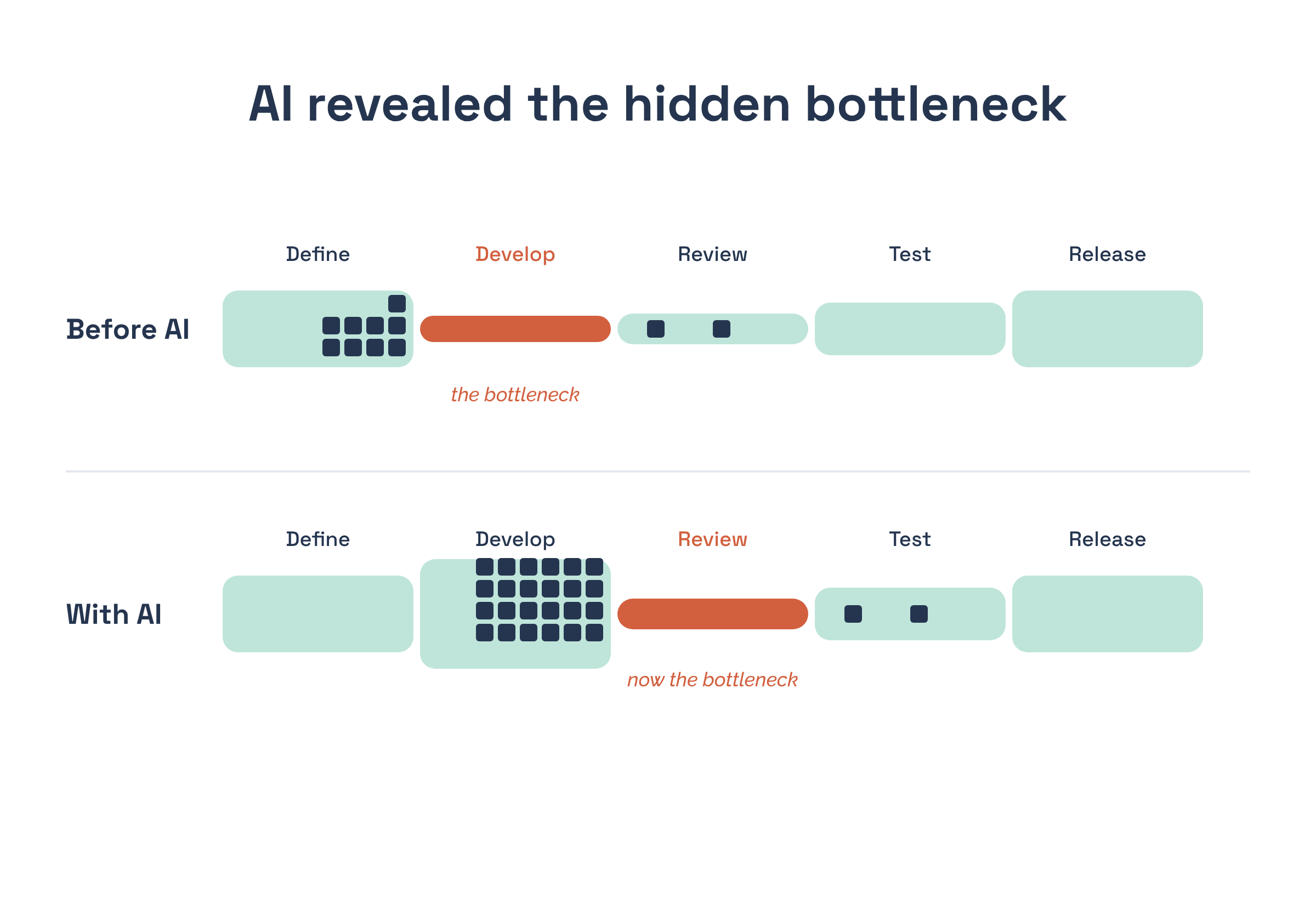
In The Goal, Eliyahu Goldratt tells a story about a scout troop on a hike. The line keeps stretching out along the trail. A gap keeps growing in front of one slow kid named Herbie, and everyone behind him bunches up. The fix is to put Herbie at the front of the line, so the whole troop moves at his pace, and then lighten his pack.
The story is an analogy for identifying and alleviating bottlenecks. In the factory at the center of the book, nobody can move the slowest machine to the front of the line, so the plant limits how much work it releases to match the bottleneck's pace. Software teams know that as a WIP limit. Agile practices grew up around code creation being the most significant bottleneck in the system, and WIP limits are based around the speed at which code development can be completed. With AI-powered development, bottlenecks that were hidden but always there are becoming apparent.
One of those Herbies is review. AI sped up writing code far more than it sped up checking it. All that new volume lands on code review, testing, and readiness reviews, practices built for the volume teams had before. I've seen it firsthand, and other leaders describe the same thing: review is where the work piles up, like the troop bunched up behind Herbie.
In the House of Software Value Delivery, these are the Tools above the pillars. Their job is to validate the software's Attributes: whether it's actually Secure, Functional, and Maintainable before it reaches users.
Under load, validation Tools fail in one of two ways. The queue grows, and the Timely gains from faster coding disappear while code waits for review. Or the review speeds up by getting shallower, and it turns into a rubber stamp. The second one is worse, because nobody notices. The review still runs on schedule. It just stops validating anything.
Goldratt's answer still works.
Put Herbie at the front. Set WIP limits to what you can validate, not what you can generate. Code that can't be reviewed hasn't moved any Attribute yet.
Lighten his pack. Smaller changes are faster to review. Automated tests can take on the checks a person doesn't need to make. AI review has a place here too, with guardrails. When AI writes the code and AI reviews it, the same blind spots can show up on both sides, and no one with the context has asked whether the software meets the needs it was built for. Let AI lighten the pack, and keep a person who owns the call.
Then measure the whole line. A team that writes code twice as fast and ships at the same pace has a Herbie problem.