Raising the Importance Line
A mentee recently asked me for advice on how to be more effective. They have great ideas for how to improve the organization, but they never get to them because they're so bogged down in an endless list of urgent to-dos.
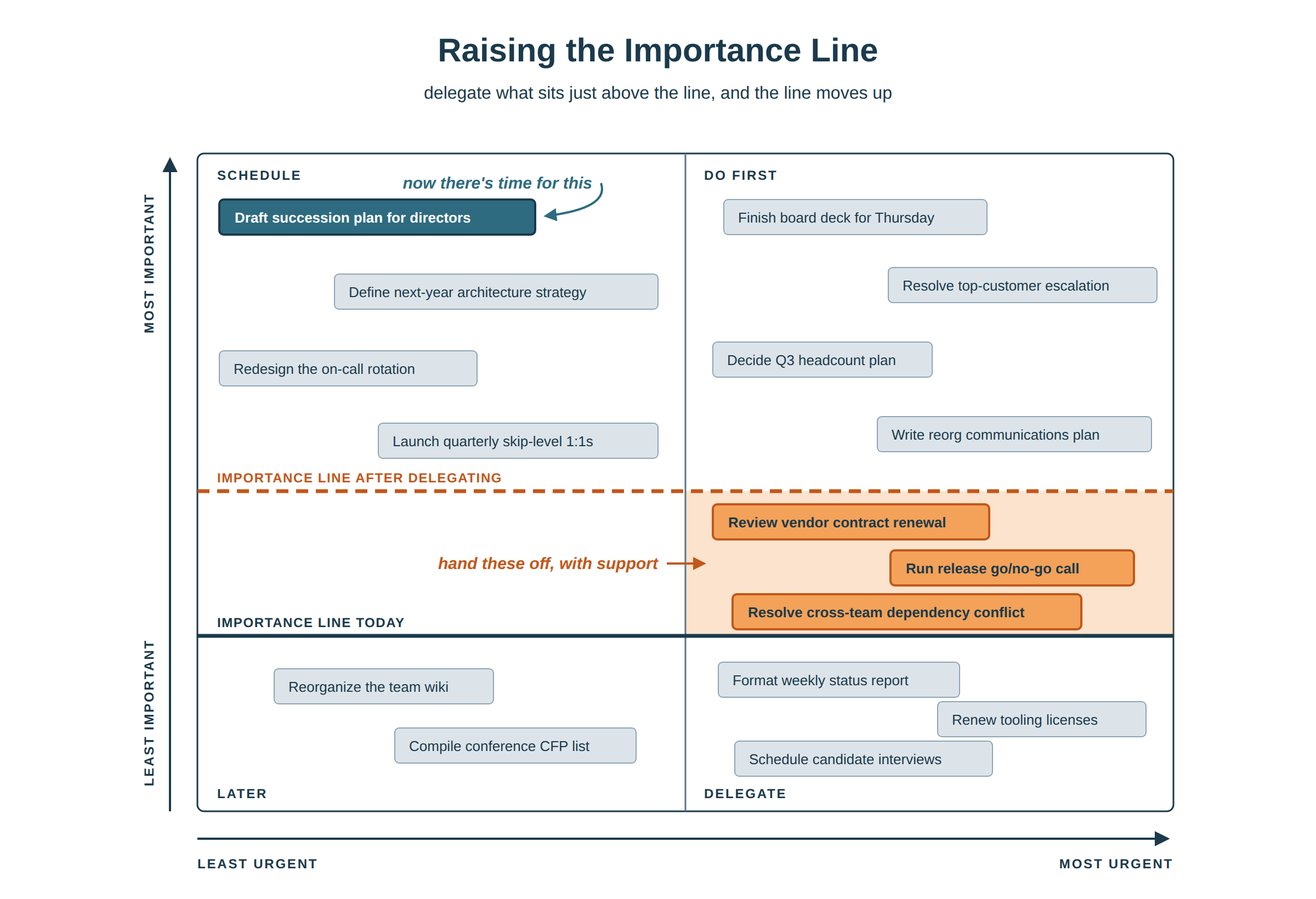
I've coached people (most often Senior Managers and Directors) through this situation countless times. We start by plotting out their current list of tasks, projects, and ideas onto an Eisenhower matrix: Importance vs Urgency. The pattern is almost always the same: Do First (Important & Urgent) is overflowing, everything in it is on fire, and you clear three things just in time for five more to land. Meanwhile those great ideas atrophy in Schedule (Important & Not Urgent), never addressed, always just out of reach.
People in that spot have tried working harder, tackling more in Do First, hoping that they'll clear it out and finally get to Schedule. The result is usually burnout and still not getting to those items. The trick isn't to do more, it's to raise your importance line.
This is the critical thing to remember: The axes on an Eisenhower matrix are continuous, not binary. Something can be a little important, or moderately urgent. So the boundary between Do First (Important & Urgent) and Delegate (Not Important & Urgent) is arbitrarily drawn. You drew it by deciding what to handle yourself and what to delegate. And you can redraw it by delegating more, strategically and a little at a time. Every time you hand off something that used to sit above your line, the line moves up and you have more space for the Schedule work.
In practice: examine the items that are sitting right at your current importance line, or just above it, specifically those on the urgent side. You're looking to identify work that's urgent and important enough to matter and small enough that a mistake won't sink anyone. Pick one of those and delegate it. With support.
The support is essential and can easily be overlooked. You have to stay close enough to catch a problem early and far enough back that the decision is still theirs. Think of it as coaching rather than a test.
Afterward, talk it through together: how it went, what they needed from you, what you'd each do differently. Next time something comes up at that same level of importance, you'll already know whether that person can handle it, and you can hand it over with a lot less hand-holding. Now your importance line has actually moved.
Do this enough times and you both grow. They're handling work that used to need you, which is how they get ready for the next role. And you finally have time for those great ideas to improve the organization.