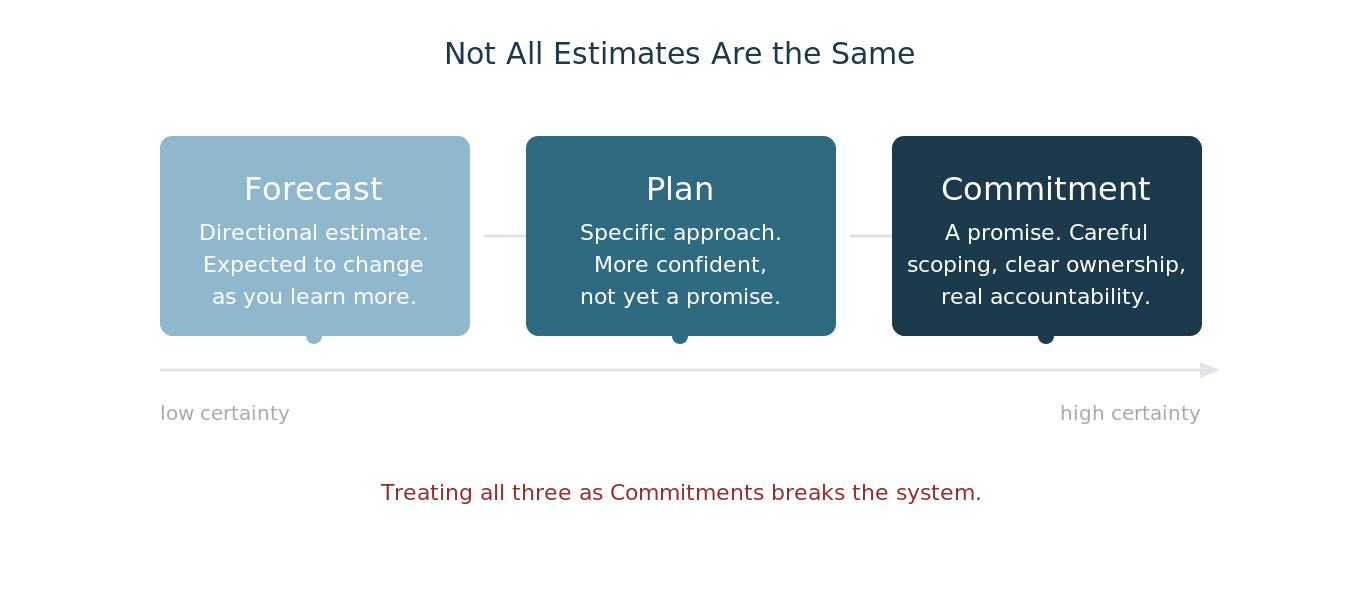
Forecast, Plan, Commitment
At some point in your career, someone asked you when something would be done. You gave your best guess based on what you knew at the time. Then that guess showed up in a roadmap, a board presentation, a customer commitment. And when the date slipped (because of course it slipped, you barely understood the problem when you gave the number), you were held accountable for the "miss."
This is what happens when organizations conflate three things that are not the same: a Forecast, a Plan, and a Commitment.
A Forecast is a directional estimate based on current information. It is expected to change as you learn more. A Plan is more refined, reflecting a specific approach and carrying more confidence, but should still not be seen as a promise. A Commitment is what you are actually promising: the result of careful scoping, clear ownership, and real accountability. These three things belong at different points in a project's life, and treating them as interchangeable breaks the system that planning is supposed to create.
The damage shows up in how teams estimate. When every number you give gets treated as a Commitment, you stop giving honest numbers. You pad. You hedge. You refuse to estimate at all until you have more information, which means leadership makes decisions without the signal they need. Or you give a number you know is wrong, because the alternative is a conversation you don't want to have. None of this makes delivery faster or more predictable. It makes it worse.
The fix is shared language. When an organization has a common vocabulary for these three levels of certainty, something changes. A team can say "this is a Forecast" and everyone knows what that means: directional, subject to revision, not a promise. A leader can hold a Commitment with real accountability without accidentally applying that same pressure to an early-stage estimate. The distinction gives teams permission to be honest, and honest estimates are the only ones worth having.
I introduced this framework with a team I led and watched it shift conversations almost immediately. The question stopped being "will you hit the date?" and started being "what kind of signal is this, and what do we need to move it from a Forecast to a Plan?" That's a much more useful conversation.