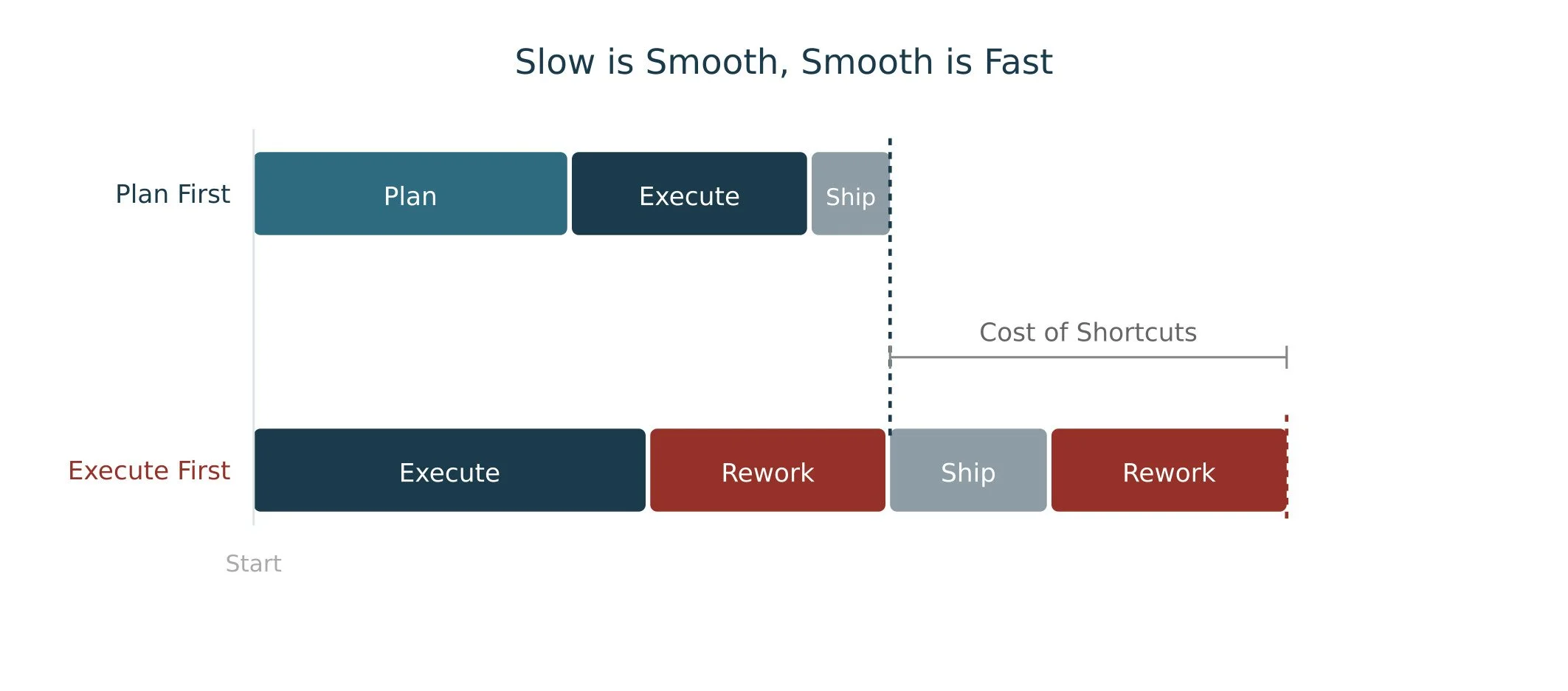
Slow is Smooth. Smooth is Fast
There's a Navy SEAL training mantra: slow is smooth, smooth is fast. The idea is that under pressure, rushing introduces errors. And errors don't just cost time to fix. They create churn.
Churn is the work that happens because something else went wrong. The feature that has to be rebuilt because the requirements weren't universally defined or understood before development started. The decision that has to be relitigated because it was made on incomplete information. The bug shipped to production that is now blocking three other teams. Every one of those situations started with someone moving faster than they should have, probably because they thought it was the right thing to do. But the time they thought they were saving must be paid back, with interest, in the form of work that has to be done twice.
This is the mechanism behind the mantra. It isn't about being slow for its own sake. It's about recognizing that the shortcuts that feel like speed are often the thing that makes you slower. Skipping the code review because you're behind. Cutting the requirements conversation because you think you already understand the problem. Merging without running the tests because they usually pass. Each of these feels like a reasonable tradeoff in the moment. Each of them is a bet that the error you're risking won't materialize. And when it does, it rarely shows up alone.
Every time I've introduced readiness checklists and reviews into a delivery process, I get the same pushback: these checkpoints are overhead that will slow delivery down. In the end, the reverse is almost always true. By spending time up front discussing and planning, delivery improves. Cycle time is reduced, quality is increased, and timelines are more predictable.
The discipline of going slow is really the discipline of doing things once and doing them right. It means asking the question before you assume the answer. It means taking the extra hour to align before you build for a week. It means treating the review not as a gate but as the thing that keeps the next ten steps from going sideways.
Slow is smooth. Smooth is fast. Not because deliberate movement is faster than urgent movement in any given moment, but because the errors you don't make don't have to be fixed.